
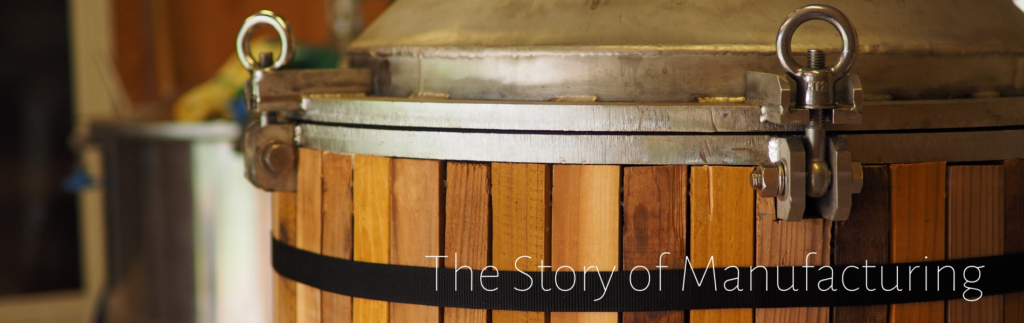
Introduction
In this first installment, I would like to introduce how we produce essential oils at Jyuhachinichi (18th).
Under our in-house brand “Kaoru Satoyama,” we distill Japanese botanical essential oils using ingredients sourced from the forests of Minami-Aizu.
We curate a wide range of fragrances with confidence, but the oils we distill ourselves hold a special significance for us.
They embody the landscape, the climate, and the hands of the people who support our work.
Our hope is that more people will discover these scents and experience the quiet beauty that they carry.
Brand Philosophy
At Jyuhachinichi (18th), our purpose is not only to distill essential oils, but also to preserve the stories and values of the forests where they originate.
We believe fragrance has the power to connect people with nature in a quiet, meaningful way.

Gathering Materials
Our work begins in the forests of Minami-Aizu, where we gather Kuromoji (Lindera umbellata), the signature botanical of our distillation.
Minami-Aizu is home to both coniferous and broadleaf woodlands, and Kuromoji thrives especially well in the shade beneath coniferous trees.
With the support of local residents who know these mountains intimately, we carefully harvest the branches one by one.
Responsible gathering is essential — we take only what is needed so that the forest can continue to flourish.
This is the first step in creating an essential oil that truly reflects the character of its birthplace.
Living in Harmony with the Forest and the People
Our work is rooted in a respect for these mountains.
We harvest responsibly and in close cooperation with local residents, ensuring that the forest can continue to thrive for generations to come.
Grind into small pieces
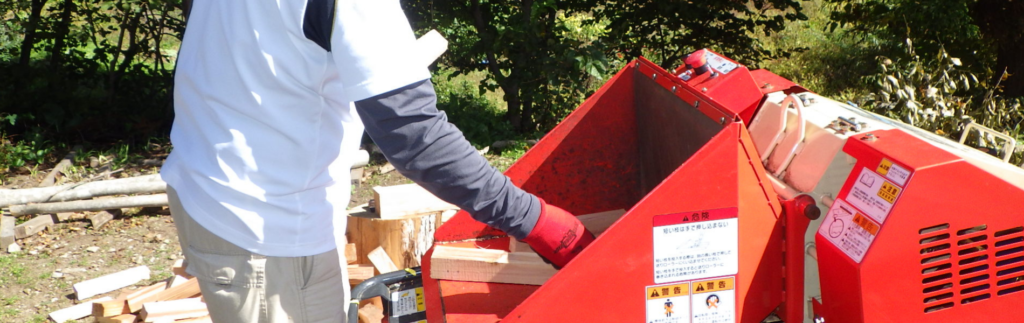
Before distillation, the harvested materials are chopped into small pieces using an industrial grinder.
This step increases the surface area of the botanicals, allowing the steam to extract their aroma more efficiently.
The grinder makes quite a powerful noise, so proper ear protection is essential.
It is a simple process, but an important one — the quality of the distillation begins here.
Distillation
Once the materials are finely ground, they are ready for distillation.
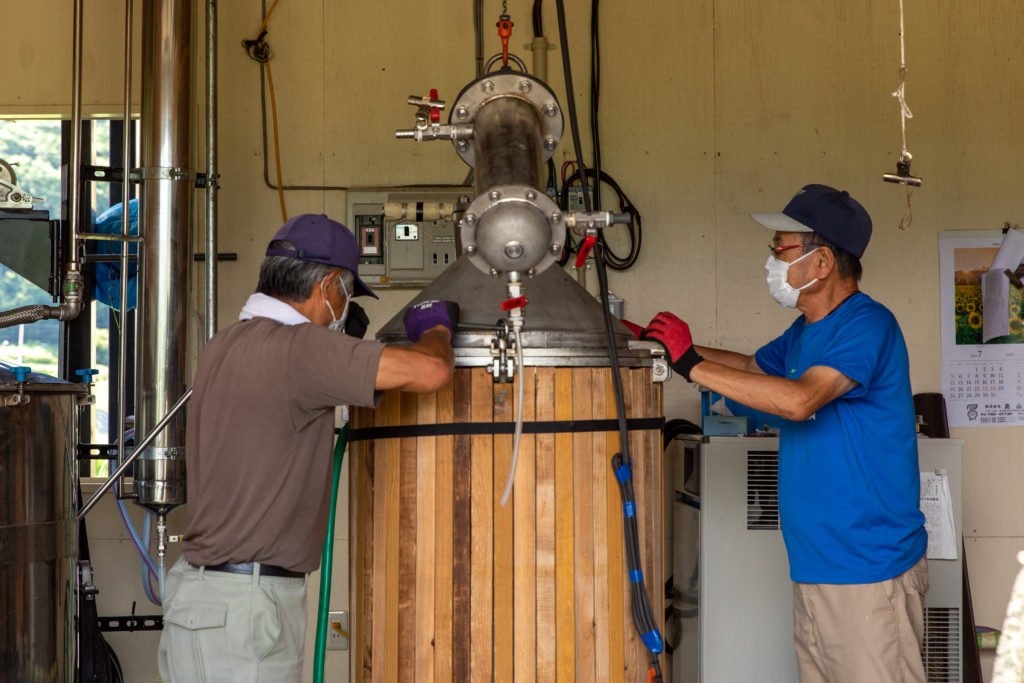
At our Minami-Aizu studio, we operate three stills ranging from 250 to 500 liters.
Each still is selected according to the material and the intended characteristics of the essential oil.
Our food-grade stills can also be used to produce flavor extracts, giving us the flexibility to work with a wide variety of botanicals.
One of these stills, affectionately known as “Unit 2,” has long been dedicated to distilling Kuromoji.
Over the years, it has quietly produced countless batches of our signature oil.
Distillation is a delicate craft.
The particle size of the crushed material, how tightly it is packed, the flow of steam, temperature control, and the length of distillation — each parameter must be adjusted with precision.
Before releasing Kaoru Satoyama Kuromoji Essential Oil, we conducted extensive trials to determine the optimal fragrance profile and chemical composition.
Even now, we continue to refine our process through ongoing experimentation and data collection, striving to create an aroma that is both consistent and beautifully expressive of the forest.
Craftsmanship defines our approach.
Every adjustment in steam flow, timing, and temperature is made with intention, allowing us to create an aroma that truthfully reflects the plant itself.
Filter, bottle, and Age
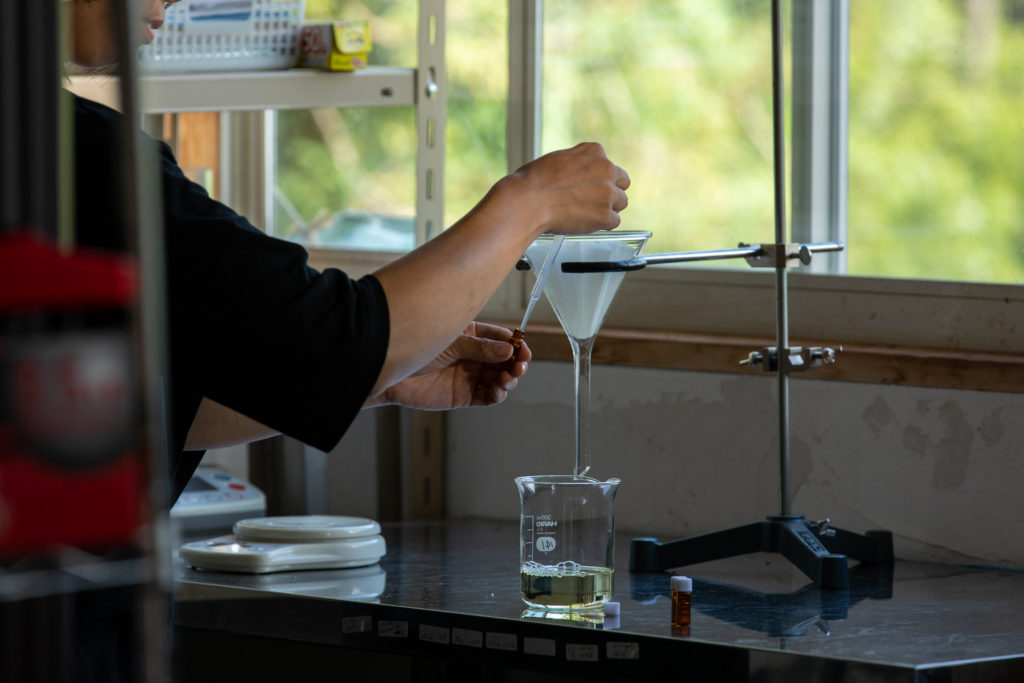
After distillation is complete, the essential oil is separated from the hydrosol and carefully filtered to remove any remaining impurities.
This step may seem simple, but it plays a crucial role in ensuring clarity, stability, and overall quality.
Freshly distilled essential oil carries a distinctive “distillation note” — a warm, slightly earthy aroma that appears only in the first hours and days after distillation.
To allow this note to settle and for the true fragrance of Kuromoji to emerge, we let each batch rest under controlled conditions.
The optimal aging time varies depending on the material, and we rely on years of accumulated data and past experiments to determine the best approach for each lot.
This quiet period of maturation brings the aroma into balance and reveals the essential oil’s authentic character.
Japanese essential oils are produced in small batches and shaped by the country’s diverse ecosystems, giving them a depth and subtlety found nowhere else.
Analysis

Once the oil has matured and its fragrance has settled into balance, each lot undergoes a detailed analysis.
At our Tokyo office, we operate both gas chromatography (GC) and high-performance liquid chromatography (HPLC) to evaluate the chemical composition of every batch.
We have established internal quality standards for each essential oil, and only those that meet these criteria are approved for shipment.
By analyzing every lot in-house, we ensure that our customers receive oils with consistent aroma, purity, and safety.
Quality is not something we leave to chance — it is verified, documented, and safeguarded through data.
This rigorous process reflects our commitment to producing essential oils that our customers can trust.
Bottled and delivered to the customer
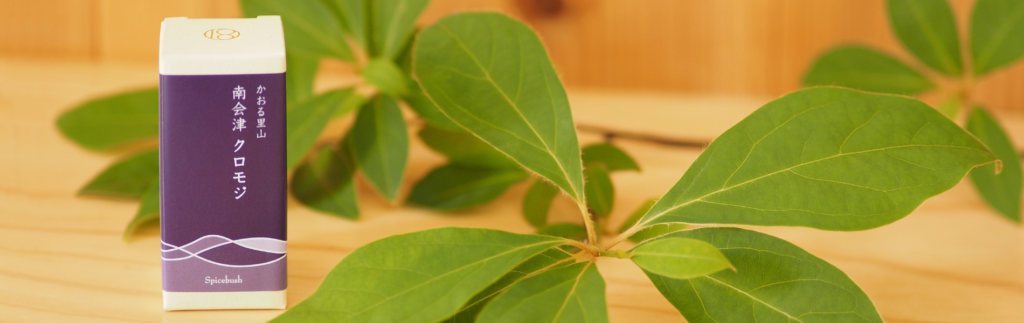
After passing all inspections, the essential oil is finally bottled and prepared for shipment.
Each bottle is filled with care, labeled by hand, and checked once more before leaving our studio.
Our products are available through select retailers across Japan as well as on our online store.
We take great pride in knowing that the scents of Minami-Aizu reach customers near and far.
Every drop in each bottle represents the forest, the people who support our work, and the many steps of craftsmanship behind the scenes.
We hope you enjoy it to the very last drop.
May these scents bring a quiet moment of nature into your everyday life.